Our History
From the founding of the foundation to a history that reaches back to biblical accounts, colonial chronicles, and the collective memory of the Guna people.
The founding of the foundation
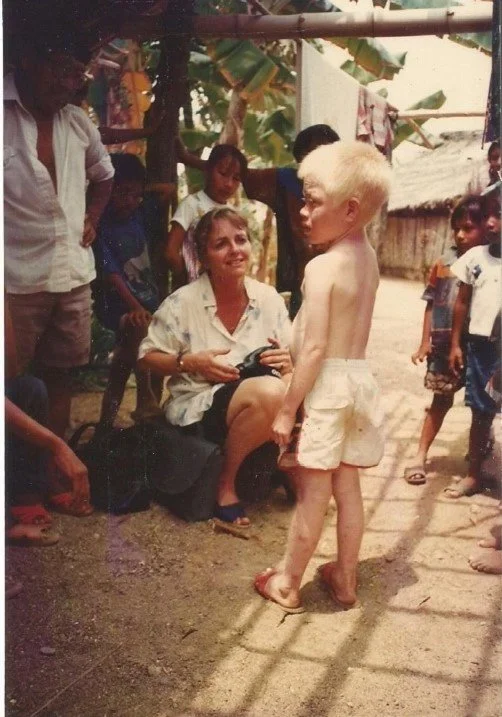
The SOS Albinos Panama Charitable Foundation was born through the initiative of Dr. Pascale Jeambrun, a French-born physician-ethnologist who arrived in Panama in 1996, interested in carrying out research on albinos.
Dr. Pascale traveled a long road to obtain authorization from Guna authorities to carry out her research. After obtaining permission from the Guna General Congress and the Congress of Culture, she visited several communities, first the community of Ustupu, where she met Cacique Harmodio Vivar (may he rest in peace), with whom she formed a great friendship. Cacique Vivar recognized the importance of this study, perhaps because within his own family there were several people with this condition.
Dr. Pascale succeeded in inspiring many of her friends — medical professionals from Panama and other countries — who joined her on her first trips to the region. Among them we can mention Dr. Reynaldo Arosemena, a Panamanian dermatologist; Dr. Étienne Bois, a French pediatrician-geneticist; and the Malian singer Salif Keita, who at the time was president of SOS Albinos International. Salif's visit was one of the events that inspired the creation and the name the foundation carries: SOS Albinos Panama.
And so the SOS Albinos Panama Foundation was legally founded on March 8, 1999. Its goals and bylaws were established, focused on watching over the full wellbeing of people with albinism in Panama, raising public awareness of the challenges faced by people with this genetic condition, and fostering inclusion, respect for their rights, and human dignity within Panamanian society.
The foundation's first board of directors was made up of:
Dr. Reynaldo Arosemena has served as the foundation's medical advisor for dermatology ever since. He provides care in the Dermatology ward of Santo Tomás Hospital and currently serves as the Foundation's Honorary President.
A history that spans centuries
Since the time of Noah
"And when the child was born, his body was as white as snow and as red as a rose, all his hair was white as wool, and when he opened his eyes the house shone like the sun."
"…Lamech was afraid of him and went to see his father Methuselah, and said to him: I have had a son who is different from other children. He is not human, but resembles the offspring of the angels; he is of a different nature than ours, entirely unlike us."
Methuselah speaks with his father, who prophesies the flood and tells him to say to Lamech that "the child is truly his son, and that he should name him Noah, for he will be a survivor." According to some historians, this is a clear biblical account referring to the birth of Noah; to them, this miraculous event describes the birth of an albino.
Early accounts of albinos around the world
From antiquity come accounts from travelers and explorers, between the 16th and 17th centuries, describing the strange presence of white men living among Black populations. Some research indicates that the word albino was first used in the late 17th century by the Portuguese priest Balthazar Telles, after seeing white-skinned Black people during his travels to Ethiopia. The term albino comes from the Latin albus, meaning white, or the white of dawn.
The first account of albinism in the Americas
It is believed that the first account of albinism in the Americas dates to the 16th century, with the arrival of Hernán Cortés, conqueror of the Aztec empire. In his accounts, he describes how Moctezuma kept, in one of his palaces, a room where he placed people considered abnormal — white of skin, hair, and eyelashes — and Moctezuma had them killed whenever there was a solar eclipse.
A second account comes from the years 1676–1695, from Lionel Wafer, a Welsh explorer, buccaneer, and privateer who served as a surgeon on the crew of the filibuster Dampier, and who spent four months on the Isthmus of Panama, in the Darién, with the Gunadule. In one of his accounts, Wafer writes:
"In this country there is a people of a very singular kind, they are white and there are both sexes among them. They are few compared to those of copper color; their skin is rather a milky white, they have eyebrows and hair as white as their skin; because they could see so clearly at night, we used to call them Moon-Eyed."
Years later there was another report of Guna albinos. It was around 1742–1748: the Jesuits were beginning their work in the province of Darién, at the request of the King and under the auspices of Viceroy Sebastián de Eslava. One of the first Jesuits to arrive in the region was Father Jacobo Walburger, S.J., who writes in the book El Diablo Vestido de Negro y los Cunas del Darién en el Siglo XVIII (The Devil Dressed in Black and the Cuna of the Darién in the 18th Century):
"…Cruelty was also unleashed when a tula child, that is, an albino, was born. Since their skin resembled that of the Spanish, many women refused to raise them… It happens that the Indian woman buries a child, or throws it in the river, when the child is tula (albino), for rare is the Indian woman who would raise such a child, because they do not wish to be the parents of children who resemble the Spanish in their flesh."
Elders maintain that during a lunar eclipse, albinos are the only ones permitted to go outside, since it was once believed that albinos were the defenders of the moon, and that if they failed, it would mean the end of the world.
From the collective memory of the Guna people and the Sipus (albinos)
According to oral accounts from great keepers of Guna culture, in the specialty of the Absogued — guardians devoted to healing ceremonies, defenders of life and of mother earth — Mago, also known as Maguniler, was the father of the first ilamagun, that is, albino. According to Guna oral history, his first kingdom was located on the mountain called Dagarguna, today part of the Darién region.
The Sipus, as albinos are also known, have passed through two stages in the Guna people's collective memory. At first they were considered children of the devil, tied to the mistaken idea of an undesirable relationship between the mother and a stranger, or a pregnancy outside of marriage; this new being was a burden for the family, for society, and therefore for the community. It was during this period that infanticide of albino children in the region was most common.
By the middle of the last century, an increase in albino births within the Guna community became noticeable. A new way of thinking emerged at that time: within the family, the birth of an ilamagun began to be seen as a blessing from Bab Dummad and Nan Dummad, who for the Guna are the creators of the world.
When an albino was born, the midwife would tell the family that the child must be very well cared for and fed: he or she was the hope of the Guna people, and was granted a special status. On nights of an eclipse, they held the duty of defending the moon against a winged dog — in the Guna language, Assu Guggwaled — being the only ones authorized to defend it during a lunar eclipse. That is why they were called "children of the moon."
According to the Guna people's worldview, the Sipus are the spiritual archers, guardians, and watchers of outer space — in the Guna language, nega du — and it is said that the albinos' dwellings in the heavenly kingdom are made of mirrors.

According to keepers of the Guna people's ancestral culture, the origin of albinos dates back to the time of Mago, who apparently had two children, one of them born albino. Much later, prophets appeared; one of them, Nele Sibu, became the leader of the albinos as the only albino prophet. To this prophet, the great father promised a special house in heaven, where only albinos may enter upon death — hence the sacred nature of albinos and the privilege they enjoy within the Guna community.
Courtesy: Mr. Baudilio Escobar
Some accounts hold that Ibeorgun himself was albino; that is why he was called Ibe, derived from "grandfather sun." They were said to be so white and radiant. It is said that for the Guna, the birth of an albino represents a blessing from Bab Dummad and Nan Dummad, and that if for any reason a newborn were rejected, it is the grandparents, with their wisdom and authority, who must intervene on the child's behalf.
Albinos and the 1925 Kuna Revolution
The 1925 Kuna Revolution is one of the most significant historical events in the Guna people's struggle in defense of their rights, and there is an element that links albinos to how this event unfolded. Excerpts taken from Aiban Wagua's book Así lo Vi, Así Me lo Contaron (This Is How I Saw It, This Is How I Was Told), based on the accounts of Cacique Carlos López, relate:
"…It was the time of Panama's separation from Colombia; Panama, the newborn Republic, was beginning a process of organizing its laws and system of government, one in which it sought to control all of its territory, including indigenous lands. There was a situation of confusion in the region: the guaguas [outsiders] arrived in our lands and seemed like friends, but little by little they turned against our people and our customs… We lived under a state of abuse and mistreatment from the colonialism that prevailed in the region."
At that time, an American named Richard Marsh was traveling through the region; he, along with other friends, had great interest in albinos, and the leaders took advantage of this contact to request help from the United States. A delegation was formed to travel to that country, using Marsh's research on albinos as a pretext; it was made up of Nigdibipe, Phillips Thomson, Alfred Kantule, and Margarita, who was the albino member of the group, with the mission of explaining the reign of terror being lived in the region and requesting support.
Guided by the teachings of Simral Colman and Nele Kantule, they prepared for February 25, the date proposed for the intervention. American authorities assigned four ships to protect the Kuna; one of them, the Cleveland, was stationed at the community of El Porvenir. U.S. mediation helped prevent the revolt from escalating further, and it ended with the signing of an agreement: the Kuna pledged loyalty to the Panamanian State, and the State guaranteed autonomy to the Kuna people.
Every year, in the month of February, in different communities across the Guna Yala region, the people gather to reenact, through popular theater, one of the most meaningful chapters in the Kuna people's struggle: the 1925 Kuna Revolution. It is a way of showing how they remember this historic event and pass it on to new generations.
Among the Guna indigenous population, a genocide against albinos also took place in the past, as has happened elsewhere in the world; however, the Guna have moved beyond this experience, fostering among their people myths and legends that regard albinos with a certain reverence, as special beings and a blessing to the family. According to traditional accounts, albinos are the hope of the people: they are the spiritual archers and guardians of outer space, the caretakers of the world, and for that reason they hold a place of honor within the community.
Learn about our mission, vision, and the meaning of our logo
Discover who we are today and where we're headed as a foundation.